
SafeHomeFirst Editorial
When you decide it’s time to upgrade your bathroom for long-term safety and comfort, the conversation usually comes down to two options: a luxury walk-in bath or a custom zero-threshold (curbless) shower.
Both are significant investments. Both require professional installation. Both will dramatically improve the safety and usability of your bathroom. But they offer completely different experiences, and choosing the wrong one can be a $15,000 mistake.
Here is a clear, unbiased comparison of walk-in baths and zero-threshold showers to help you make the right decision for your home and your lifestyle.
The Core Difference in Experience
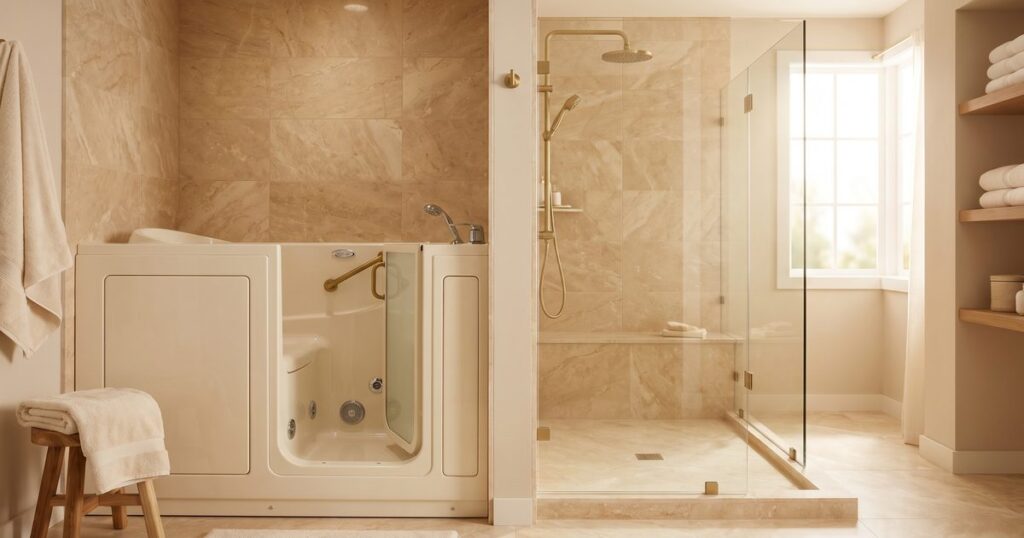
A zero-threshold shower is about efficiency, seamless design, and absolute accessibility. You walk (or roll) straight in, without stepping over a curb. It feels modern, open, and spa-like in a minimalist way.
A luxury walk-in bath is about hydrotherapy, deep relaxation, and therapeutic relief. It’s a seated experience designed to soothe joints and muscles with warm water and jets. It feels like having a private hot tub in your home.
Walk-In Baths: The Pros and Cons
The Advantages
- Therapeutic Benefits: This is the primary reason to choose a walk-in bath. Premium models offer air jets, whirlpool jets, and chromatherapy that can significantly relieve arthritis, muscle pain, and circulatory issues.
- Seated Safety: You are seated securely during the entire bathing process, eliminating the risk of slipping and falling while standing on wet surfaces.
- Deep Soaking: Unlike standard tubs, walk-in baths are deep enough to submerge your torso and shoulders comfortably while seated.
The Drawbacks
- The Wait Time: You must enter the tub and close the door before filling it, and wait for it to drain completely before exiting. Even with fast-drain technology and heated seats, this requires patience.
- Space Requirements: While they often fit in the footprint of a standard tub, their height can make a small bathroom feel cramped.
- Water Usage: They require significantly more hot water than a shower, often necessitating a water heater upgrade.
Zero-Threshold Showers: The Pros and Cons
The Advantages
- Immediate Access: You turn the water on, wait for it to warm up, and step in. There is no waiting to fill or drain.
- Absolute Accessibility: Because there is no curb whatsoever, they are completely wheelchair and walker accessible, making them the ultimate long-term aging-in-place solution.
- Aesthetic Appeal: Curbless showers are highly sought after in modern luxury home design. They make bathrooms look larger, cleaner, and more expensive. They are generally considered better for resale value than walk-in baths.
The Drawbacks
- No Soaking: If you love taking baths to relax muscles or simply unwind, a shower—even one with multiple body sprays and a bench—cannot replicate the experience of deep water immersion.
- Installation Complexity: Creating a curbless shower often requires recessing the floor joists to create the necessary slope for drainage. This can be structurally complicated and expensive, particularly on second floors or concrete slabs.
- Temperature Control: Open showers can feel drafty compared to the enveloping warmth of a deep bath.
Cost Comparison
In most markets, the costs are surprisingly similar, though the money goes to different places.
- Walk-In Bath ($10,000 – $20,000+): You are paying primarily for the complex product itself (the tub, jets, heaters, pumps) and the electrical/plumbing upgrades to support it.
- Zero-Threshold Shower ($12,000 – $25,000+): You are paying primarily for skilled labor (structural floor modifications, custom waterproofing, extensive tile work, and custom glass enclosures).
The Verdict: Which Should You Choose?
Choose the Zero-Threshold Shower if: You prefer showering to bathing, you want to maximize the resale value of your home, you prioritize a modern aesthetic, or you need absolute wheelchair accessibility.
Choose the Walk-In Bath if: You suffer from arthritis or chronic pain that benefits from hydrotherapy, you genuinely love taking baths, and you are willing to trade the speed of a shower for the therapeutic benefits of a deep soak.
Related reading: the complete guide to walk-in baths | walk-in shower vs. walk-in tub | 5 things nobody tells you about walk-in baths
Related reading: grab bars that actually look good | the best handheld shower heads | how much a walk-in bath actually costs | Kohler vs. American Standard walk-in baths